
Navigation
Install the app
How to install the app on iOS
Follow along with the video below to see how to install our site as a web app on your home screen.
Note: This feature may not be available in some browsers.
More options
You are using an out of date browser. It may not display this or other websites correctly.
You should upgrade or use an alternative browser.
You should upgrade or use an alternative browser.
Garmin depth sounder doesn’t work except idle speed
- Thread starter Mark D
- Start date

Jack M
Moderator
Mine stops at between 15 - 20

Link
Moderator
Used to happen on mine solved by tilting the transducer angle so the back is down lower
warrior999
Well-Known Member
I mentioned mine not working beyond about 16mph to good fishing buddy of mine. He told me that's exactly how it's supposed to work. He also offered to come ride with me for a few hours to show me all of the features that it WILL do besides depth. I'm sure it will cost me a few adult beverages for his consultation fee!

Tin Diesel
Well-Known Member
There's a lot of info online about how to adjust your transducer - some on this forum, and a lot on other boating/fishing forums and YouTube. I installed a new Humminbird about 6 months ago. Initially, it wouldn't read above 3-4 mph, so I adjusted it. I got it to read up to 10 mph, and adjusted it again. Now I get 18-20 mph. I've seen online that some guys claim to get readings at 30-40 mph, [edited out: doubtful comments about depth readings at high speed!]
The transducer head will read best when nearly horizontal but not quite... it should be tilted down slightly at the back. This reduces cavitation and turbulence over the sender. As I recall from the installation process, I came to the conclusion that there's a trade-off. The trade-off is that as your speed changes, the level of the transducer changes, which impacts its effectiveness. So what works at low speed may not work at high speed. At what speed to you want a reading? This will also be impacted by how you trim out your boat at speed.
When visually looking at your transducer (when out of the water) you have to remember that pontoon boats sit by the stern when in the water (unless you're this guy and put sandbags in the front seat compartments: http://club.benningtonmarine.com/threads/new-boat-does-not-sit-level.9045/)
So, your initial installation is not going to be where the transducer is parallel to the bottom of your hull. When you're in the water, you need to determine the angle of tilt (there's a YouTube video where a guy uses a level on the side rail and stacks pennies at one end until its level. Then he counts the pennies and when the boat is out of the water, he uses the trailer front jack to tilt the boat until that angle is repeated.) In my case, having bought a used Benny from my brother, I just used the existing watermark as a guide, knowing I would be fine tuning anyway. My boat is on and off the trailer all the time, so I have the luxury of fine tuning when I have it out of the water.
Anyway, your initial setting should be:
At 30+ mph I rely on the built in charts on my Humminbird to stay out of trouble.
The transducer head will read best when nearly horizontal but not quite... it should be tilted down slightly at the back. This reduces cavitation and turbulence over the sender. As I recall from the installation process, I came to the conclusion that there's a trade-off. The trade-off is that as your speed changes, the level of the transducer changes, which impacts its effectiveness. So what works at low speed may not work at high speed. At what speed to you want a reading? This will also be impacted by how you trim out your boat at speed.
When visually looking at your transducer (when out of the water) you have to remember that pontoon boats sit by the stern when in the water (unless you're this guy and put sandbags in the front seat compartments: http://club.benningtonmarine.com/threads/new-boat-does-not-sit-level.9045/)
So, your initial installation is not going to be where the transducer is parallel to the bottom of your hull. When you're in the water, you need to determine the angle of tilt (there's a YouTube video where a guy uses a level on the side rail and stacks pennies at one end until its level. Then he counts the pennies and when the boat is out of the water, he uses the trailer front jack to tilt the boat until that angle is repeated.) In my case, having bought a used Benny from my brother, I just used the existing watermark as a guide, knowing I would be fine tuning anyway. My boat is on and off the trailer all the time, so I have the luxury of fine tuning when I have it out of the water.
Anyway, your initial setting should be:
- With your boat at the same aft tilt as when in the water, transponder is horizontal minus a few degrees aft (back end tilted down) to compensate for turbulence/cavitation.
- Then (in my case) a few less degrees of aft tilt (bringing the back tip up some) to adjust for trim at speed.
At 30+ mph I rely on the built in charts on my Humminbird to stay out of trouble.
Last edited:
warrior999
Well-Known Member
Can you imagine going 30mph and reading your depth at 18ft and then it going to 1ft.
At that point, you would no longer be reading the screen You would be laying 10 yards IN FRONT of your boat wondering what the hell just happened. Also thinking, well that's going to cost a bunch to fix.
At that point, you would no longer be reading the screen You would be laying 10 yards IN FRONT of your boat wondering what the hell just happened. Also thinking, well that's going to cost a bunch to fix.
DaveyJ
Well-Known Member
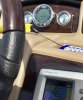
I adjusted my transducer this past summer and am now able to get 30+ MPH out of it. I lowered it and moved it closer to the outer edge of the toon such that the bottom of the transducer is below the bottom of the toon. The pic attached is not my boat but the location is where I moved mine to and is identical to my transducer. The other pic is proof I'm not blowing smoke.  My transducer was originally mounted near the center of the toon and up about an 1" or so from where it is now. In its current location, I will still occasionally lose signal but it's much more reliable than before.
My transducer was originally mounted near the center of the toon and up about an 1" or so from where it is now. In its current location, I will still occasionally lose signal but it's much more reliable than before.Attachments

Tin Diesel
Well-Known Member
Yeah, its important to keep it on the side, and below the level of the toon... reduces turbulence. You've inspired me to try to keep fine tuning!!!!
Michiman
Well-Known Member
I had the same problem with my Garmin Echo (basic fish finder/depth gauge) not working over 12 to 14 MPH. Last summer before I launched it for the season, I moved it slightly outboard and down to the point that the unit is slightly lower than the pontoon and it now works almost to WOT. That said, because it hangs down it could be prone to damage if you beach your Benny or have a lift where the end of the pontoon sits on a support. Neither apply to me so I'm a happy camper! Thought I took a picture of it's new mounting position but alas, I guess not. Not blowing smoke...
Tin Diesel
Well-Known Member
OK OK.... I'm gonna go edit out my comment about not believing anybody who says theirs works over 30 mph!!!


Vikingstaff
Moderator
I had the same problem with my Garmin Echo (basic fish finder/depth gauge) not working over 12 to 14 MPH. Last summer before I launched it for the season, I moved it slightly outboard and down to the point that the unit is slightly lower than the pontoon and it now works almost to WOT. That said, because it hangs down it could be prone to damage if you beach your Benny or have a lift where the end of the pontoon sits on a support. Neither apply to me so I'm a happy camper! Thought I took a picture of it's new mounting position but alas, I guess not. Not blowing smoke...
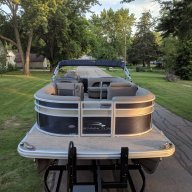
I know you posted a picture of it after it was remounted last spring. It is barrier somewhere in these forum threads.
the-little-B
Well-Known Member
- Messages
- 220
- Reaction score
- 202
My humminbird reads at full throttle on mine which is 28-29 mph on a good day. The transducer needs to be mounted low enough to get it out of the pontoons turbulence. To adjust it so it's level when the boat is in the water...either adjust it while the boat is floating , or take a level off of the water line on the side of the boat and adjust the transducer to the same.
Oldchuck
Well-Known Member
Given the way a toon rides I can see why they will cause more problems than a traditional vessel due to the cavitation and turbulence created as you try to push a toon to higher speeds however, Tin Diesel is correct in that it can be done but just takes time and effort to get the transducer into "good" water.
adkboater
Well-Known Member
Mine reads clear past 30mph but it took me a few shots to get it adjusted
BigKahuna
Well-Known Member
Tin...... Ours has always worked at all speeds. Never a problem since we got it.OK OK.... I'm gonna go edit out my comment about not believing anybody who says theirs works over 30 mph!!!
Tin Diesel
Well-Known Member
I went out today and tweaked mine again (aft end downward) but I'm really just guessing at this point and won't be able to test it out for a couple of weeks. It would be super if some of the guys getting high speed readings could post photos of their setup..
adkboater
Well-Known Member
Mine is on the left tube, I have the angle set so it’s flat while on plane. It is also completely below the tube so it’s not getting any “dirty water”.