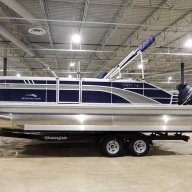
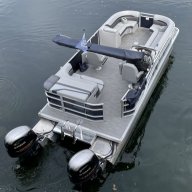
Sorry for delay. Update.
I just got off the phone with the Sea Legs customer service/tech rep. for Michigan. I inquired first about the issue before sharing “why” I was inquiring. Paraphrasing what he said.
Sea Legs Tech Rep:
Sea Legs: They have really built them up significantly in regards to durability specifications of all parts while trying to reduce weight of their overall system, over the last 20 years. They are built for the boat to be extended to ANY HEIGHT in the range of motion and set at rest that way. In particular, their triple tube legs are built to hold up boats with 2-3 large motors. Sea Legs stands behind that engineering, and has no restrictive recommendations on their usage within their range of motion. He recommended putting them 8-10” above water if on a calm lake, perhaps 1’ or slightly higher if on a rough and wavey lake.
After hearing WHY I was inquiring (this thread), he shared perhaps this is a specific concern of some competing legs, or specific year or models of some of their competitor’s legs. He spoke in particular about Ultra Legs as an example. He said the hydraulic cylinders and seals in the Ultra Legs do not seem to be as robust as theirs. He said that for 2 motor triple tube pontoons Ultra Legs does not install their system, and recommends those customers directly to him over at Sea Legs. He said he does not know in detail their engineering specs or deployment recommendations/restrictions. However, his understanding is they can sometimes have issues with their hydraulic cylinders and seal leaks due to supporting too much weight. Thus, he said it makes sense on some of their customers set ups that they might make a recommendation such as fully deploy when the boat is put up on them to reduce hydraulic system stress. However, he said that is just speculation based on what he knows about their limits on much heavier triple tube and multi-motor triple tube pontoons vs. the weight and lift capabilities of the Ultra Legs product.
Me:
None of the above is my opinion, and it is coming from a specific manufacturer commenting about their product as well as speculating about a competitor product. Take that for what it is worth. Maybe he is being 100% straight and is correct. Maybe I was getting a bit of salesmanship and marketing sprinkled in. I don’t know, and don’t really have skin in that game. Just passing along the contents of our conversation.
My Takeway: Minimally, for those of us with Sea Legs, he was 100% clear on their being NO deployment restrictions, or even restrictive recommendations. He echoed what some of us have shared over the years and even a bit above. Kind of a balancing act between minimizing the possiblity of wind updraft underneath a pontoon in a MAJOR storm with always staying above any potential wave action that might provide bouyancy and floating lift on pontoons.
He said for my boats weight range (24’ Bennginton with a 200HP Mercury), it should take in excess of 100mph straight line winds to really lift and flip a setup such as mine. Thus, the chances of lift and a flip or tip on a boat like ours is VERY minimal. So he also said, that likely is not a likely scenario in most cases. He did say though with lighter boats, that becomes more of a concern, and thus keeping the boat raised just above highest wave possibility so as to minimize chance of wind updraft is more highly recommended with those lighter boats.