
It's not the effort to steer at all with mine that is the problem, it's the motor flopping back and forth with the waves while going slow and the steering wheel jerking back and forth. Literally inches of movement and Bennington insists this is normal. I even sent them a couple of videos. Their reply is I need hydraulic steering. The play is definitely in the gear box. Both the dealer and Bennington have refused to look at it.

Navigation
Install the app
How to install the app on iOS
Follow along with the video below to see how to install our site as a web app on your home screen.
Note: This feature may not be available in some browsers.
More options
You are using an out of date browser. It may not display this or other websites correctly.
You should upgrade or use an alternative browser.
You should upgrade or use an alternative browser.
What size motor?
- Thread starter Patrick Szuch
- Start date
Michiman
Well-Known Member
Some great input from people with experience in such matters! Not speaking from experience myself but having read a lot on this board over the past two years, I'm going to change my position and say that the 115 might be a bit much without the lifting strakes and hydraulic steering. And if you want to do water sports, you've got that bass boat. Good luck with your decision...
Patrick Szuch
Active Member
- Messages
- 42
- Reaction score
- 88
Definitely lots of great info and differing opinions I am hearing on the matter. Though I do think the 50 is sufficient for my intended uses of the Bennington, I may opt for one of the larger options simply for the resale aspect. A 90hp might be a good compromise between budget and performance for me. The couple thousand difference in price now may well be recouped if i ever sell the boat down the road - though I am truly looking at it as my forever boat now.

Pittsburgh
Commodore
I have the SL21 with a Yamaha 90 hp on a small private lake
For me it fulfills all my desires
I would not go under the 90hp
The money savings is minimum but the resale would suffer significantly
Having 6 - 10 American Adults on a boat could add 2000 lbs easily
Having the extra horsepower in the no-wake zone would be enjoyable
My recommendation would be the 115 if financially possible for you
You will never second guess or regret your decision

For me it fulfills all my desires
I would not go under the 90hp
The money savings is minimum but the resale would suffer significantly
Having 6 - 10 American Adults on a boat could add 2000 lbs easily
Having the extra horsepower in the no-wake zone would be enjoyable
My recommendation would be the 115 if financially possible for you
You will never second guess or regret your decision
Last edited:

That is strange. I have a 115hp and don't experience any problems. Your problem doesn't sound normal - I don't have hydraulic steering.It's not the effort to steer at all with mine that is the problem, it's the motor flopping back and forth with the waves while going slow and the steering wheel jerking back and forth. Literally inches of movement and Bennington insists this is normal. I even sent them a couple of videos. Their reply is I need hydraulic steering. The play is definitely in the gear box. Both the dealer and Bennington have refused to look at it.

SEMPERFI8387
Moderator
Buy what fits your needs and the water you plan to use it on. If that accomplishes both tasks you need not be concerned with resale value! I have owned at least eight pontoons,with the first having a Evinrude 50. My last 4 have been Benny's and the "Resale" on them is so good that your boat would sell if it had a trolling motor for power!

kaydano
Well-Known Member
- Messages
- 4,317
- Reaction score
- 2,243
Motor size and hull type go hand in hand. For the same reason you don't put a V8 in a Prius. With two round tubes, 50-70 max. Any bigger, switch to a better hull first.
And NEVER EVER buy a 115. I had one. Biggest waste of money in my entire life. That and cotton candy.
And NEVER EVER buy a 115. I had one. Biggest waste of money in my entire life. That and cotton candy.

BulldogsCadillac
Just some guy
I would jump to the 90. My first boat was a 90hp 2075 GLi and when I traded it in after 2 seasons my dealer had NO problems selling it, even AFTER someone backed into it on my drive to trade it in!! So as others have said, for resale it definitely makes it more marketable to someone just starting out in the world of pontoons, (assuming they haven't made it to this forum and let us spend their money) or someone in the same kind of scenario as you. The 90's are still quite fuel efficient too. With a load of 6-10 adults it would definitely be suitable for your use. In my honest opinion.
Michiman
Well-Known Member
I sense a great story!That and cotton candy.

Maynard G. Krebs
Well-Known Member
- Messages
- 307
- Reaction score
- 316
I have a 50 on my 20' and for two people it's fine but really fell flat when we added 400-500 pounds of passengers. My top speed of 21 mph fell to about half that and I couldn't get anywhere near being up on plane. Full throttle at 10 mph is aggravating. My vote is for the 90.
SEMPERFI8387
Moderator
Full throttle at 10 mph is aggravating.
You just ain’t used to it .....

Motor size and hull type go hand in hand. For the same reason you don't put a V8 in a Prius. With two round tubes, 50-70 max. Any bigger, switch to a better hull first.
And NEVER EVER buy a 115. I had one. Biggest waste of money in my entire life. That and cotton candy.
Kaydano
I have heard many stories about the generation one 115 Yamaha being a real heavy dog and I suspect this might be what you had? I did some research on the Yamaha site about the generation two and it has a bunch of improvements and specs out at 126 HP and it is like 30 lbs lighter. I would not say the gen two is a total waste of money based from my experience with my 2017 but I do agree it's not enough for my SX24 swingback to get wild on the water. Once the grand kids start tubing we will be upgrading to a 150.
Last edited:
kaydano
Well-Known Member
- Messages
- 4,317
- Reaction score
- 2,243
It was a Merc 115.
kaydano
Well-Known Member
- Messages
- 4,317
- Reaction score
- 2,243
Every displacement hull has a theoretical max speed in which no matter how much power you throw at it, the boat will not go any faster.
I've read about it a couple times. And I can't explain it in detail. But the physics behind it has to do with the wave the bow creates in front of the boat. The more horsepower you throw at it, the larger the bow wave gets and pushes back against the force of the motor. Think of it like a train trying to climb a hill, except the more power the engine has, the steeper the hill gets, and the speed of the train will never go faster than a certain limit. The bow wave is like the hill, and the displacement hull can never climb over it, no matter how much power, because the wave just keeps getting bigger.
Here's the hard part to grasp for me. There's a mathematical formula for this, and the max speed is proportional to the length of the hull. The larger the hull, for displacement hulls, the faster that max speed is. Unfortunately, the longer the hull, the more the boat weighs, and the more horsepower you need for both the weight and the speed. There becomes a practical limit, such as in the case of an aircraft carrier, where there's a practical limit to the size of the engine.
Back to the pontoon boat and the question at hand on weather a 50 or 90 is best. Just pointing out there's a max speed that no matter how much engine you add, the speed will only increase by small increments. For displacement hulls that is. Planing hulls are able to climb over that bow hill, or wave, and then the boat speed increases as you add horsepower until you run into this same problem again, only next time it's with air resistance. More on that in a minute.
If someone can find the formula, you could calculate the theoretical max speed for a 22 or 24 foot pontoon boat with a displacement hull. This also explains why at some point you are better spending your money on a hull that planes up, and then go back to adding horsepower.
Doubt any of that helps much. 90 hp might be that point. Maybe 70 hp. Explains why you never see a 150 on a twin round pontoon with no strakes.
The wind resistance limit shows up in the speed numbers when you compare some of the top speeds of similar boats on this forum when one has a 250 and another has a 350. Top speed doesn't increase much for that additional 100 hp. Until you climb over the "air resistance" hill/wave. At which time, you'd be in outer space.
I've read about it a couple times. And I can't explain it in detail. But the physics behind it has to do with the wave the bow creates in front of the boat. The more horsepower you throw at it, the larger the bow wave gets and pushes back against the force of the motor. Think of it like a train trying to climb a hill, except the more power the engine has, the steeper the hill gets, and the speed of the train will never go faster than a certain limit. The bow wave is like the hill, and the displacement hull can never climb over it, no matter how much power, because the wave just keeps getting bigger.
Here's the hard part to grasp for me. There's a mathematical formula for this, and the max speed is proportional to the length of the hull. The larger the hull, for displacement hulls, the faster that max speed is. Unfortunately, the longer the hull, the more the boat weighs, and the more horsepower you need for both the weight and the speed. There becomes a practical limit, such as in the case of an aircraft carrier, where there's a practical limit to the size of the engine.
Back to the pontoon boat and the question at hand on weather a 50 or 90 is best. Just pointing out there's a max speed that no matter how much engine you add, the speed will only increase by small increments. For displacement hulls that is. Planing hulls are able to climb over that bow hill, or wave, and then the boat speed increases as you add horsepower until you run into this same problem again, only next time it's with air resistance. More on that in a minute.
If someone can find the formula, you could calculate the theoretical max speed for a 22 or 24 foot pontoon boat with a displacement hull. This also explains why at some point you are better spending your money on a hull that planes up, and then go back to adding horsepower.
Doubt any of that helps much. 90 hp might be that point. Maybe 70 hp. Explains why you never see a 150 on a twin round pontoon with no strakes.
The wind resistance limit shows up in the speed numbers when you compare some of the top speeds of similar boats on this forum when one has a 250 and another has a 350. Top speed doesn't increase much for that additional 100 hp. Until you climb over the "air resistance" hill/wave. At which time, you'd be in outer space.
Last edited:
Kurt
Member
My first pontoon in 2007 was a basic twin log Starcraft with a 60hp mercury Bigfoot. We cruised the Mississippi and sometimes into a decent current without issues. We cruise really slow so that we dont have issues with wind blowing our snacks and wine glasses around, definitely below wake speed. We also got really good gas mileage. The reason we upgraded is that if bad weather came, we needed to get home more quickly since on the river you may go a few miles up or downstream.
Regarding resale, if the upgrade is $4k you may get $2k back although it may sell EASIER. This being said, I had no trouble selling mine because there are always people who just need an “entry level” toon. In fact, I lost far less % of original purchase price on that toon than I did with my $45K twin log with a 115 w/hydraulic steering!
Hope that helps.
Regarding resale, if the upgrade is $4k you may get $2k back although it may sell EASIER. This being said, I had no trouble selling mine because there are always people who just need an “entry level” toon. In fact, I lost far less % of original purchase price on that toon than I did with my $45K twin log with a 115 w/hydraulic steering!
Hope that helps.
Pittsburgh
Commodore
I always wondered about resale of pontoons and other watercraft
Surprisingly here at The Lake there is a market for used pontoons and other water craft
Seems like many hold their value

Surprisingly here at The Lake there is a market for used pontoons and other water craft
Seems like many hold their value
Spoiledrotten
Well-Known Member
Ok, I’m normally on the horsepower band wagon but....... in your situation my only concern would be a loaded boat and resale so I’m thinking the 90hp would be worth the extra cost plus having that little extra oomph in case a storm or in an emergency would be comforting. Yes I’ll say it, the 115hp would probably not be worth it!
So far, up to this response that I quoted, this is the answer that I like. I had a 20 two log with my first Benny, and when I sold it, it went within 15 minutes of my decision to sell.
Steve21slx
Well-Known Member
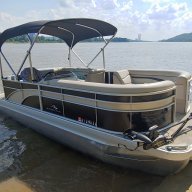
I have the 21slx which is 21'10". It will top out at about 28MPH on a light load with the 90hp yamaha and standard prop. I don't think I would go below a 90 hp. Even in your case you still want some extra speed just in case.
Spoiledrotten
Well-Known Member
I'm with Steve on that. Mine would do 28, but I had seven in it one evening, trying to get out of a storm, and it maxed out at 15 MPH.