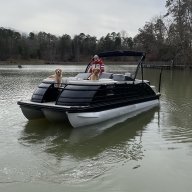
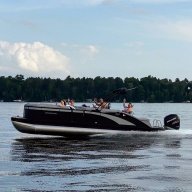
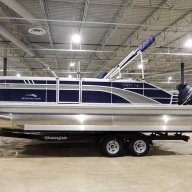
IMHO…off the top of my head:
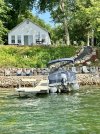
Pros: Lift the boat up out of water ANYWHERE you are in 5-6’ or less of water. Great for docking, sand bars, beaches, visiting others, etc… Just pop it up on the Sea Legs and do what you want to do. For example, no managing tying up with bumpers and related concerns as your boat will stay solidly in place. No anchor line & boat management in shallow situations for same reasons. Just lower Sea Legs, and plant that boat precisely and firmly in place!
Doesn’t really cost more than a higher quality solar power lift and canopy system. From a cost perspective, its in the range depending on what one might get, but provides greater flexibility than a heavy and fixed lift.
Easy to use and operate. You have a couple switches on the unit as backup, and you also have a remote (my preference), and you a phone app. Just as simple as a power lift, but with more flexibility of use.
If you operate on water with fluctuating lake depth levels (our situation), the flexibility of Sea Legs is tremendous compared to a heavy in place lift. No more worrying about being stuck on a lift if water level drops too low. As long as your boat can float, you can drop the legs and go…even if so shallow you have to walk it.
If you are in a climate where you’d have to pull your lift out annually (winter - our situation too), then this eliminates doing so as well as not needing yard space for lift storage. In a nutshell, you always have your lift with you for whatever you might want to do and you don’t have to worry about another item seasonally or when your boat is not in the water. It’s simply always with your boat, and it’s tucked away inconspicuously beneath it.
If you would have otherwise had a lift system with a canopy, no more tight spaces to dock between with canopy supports. With the Sea Legs, you can be as precise or as sloppy dockside as you wish (although probably not a benefit in a slip situaiton).
Cons: (most of these are minor, but worth mentioning).
You are carrying the extra weight of about 2 male occupants on board because of them. So you should factor that against capacity plate. As a result of always having that extra weight and displacement beneath the boat, you will lose 3-5mph at WOT and across the performance range for whatever load you normally carry.
I was very hung up on potential performance loss (hence originally trying a traditional lift first when we boat our boat in 2017). Thus, I spent a lot of time researching the impact on it. It seems to be a loss of 3-5mph depending on boat (weight, toons, layout) and motor (HP).
For us specifically, we lost 3 mph at WOT on a light load (went from 45mph to 42 mph WOT) , and we edge closer to 5 mph less when loaded down with a full crew and gear (went from 40 mph to about 35-37 mph WOT). For reference, 24’ SSBXP SPS tritoon, 200HP Mercury Verado Pro. Consequently, you will use more throttle and be at higher RPM’s for whatever speed you want to go because you have that extra weight all the time + your passengers and gear.
A couple usage nuances. Not cons per see, but nuances. With a tritoon in particular, you have 4 indepdent legs coordinated off remote or app buttons. You have to tweak raising and lowering with buttons to keep it level or at your desired angle. Easy, but something you have to do.
Remote range is poor. You have to be somewhat close, and metal obstructions (side railings) interfere. No biggie, but wonky sometimes depending on dock situation.
If you don’t “trip” the in line sea legs circuit breaker switch, they are always a slow draw on the battery. Basically a parasitic draw. Tripping the toggle switch circuit breaker eliminates that draw. However, if unaware or you forget, and your boat sits for a few weeks, you can drain down your battery too low to operate.
Along with that, there is a minimum voltage (+/- 12 volts) necessary or the Sea Legs wont work. It’s supposed to be a safety feature to protect battery to insure cranking power for your motor. However, if up on your Sea Legs, and the battery is low, well then…you need to charge your battery to lower sea legs to then start the boat. It’s a kinda backwards safety feature IMO. So managing the item above, and having good battery health are important or you could be stuck up on the Sea Legs until the battery is charged or replaced.
If you would have had a canopy cover with your lift (we did), then you lose it when switching to Sea Legs and have to go back to covering your boat thoroughly with the mooring cover. Once we got used to covering it thoroughly with the mooring cover, we were fine. Only takes us 5, maybe 8 minutes. But it’s certainly not as easy as just parking it under a lift canopy and knowing you can be sloppy with laxadasicaly mooring cover use.